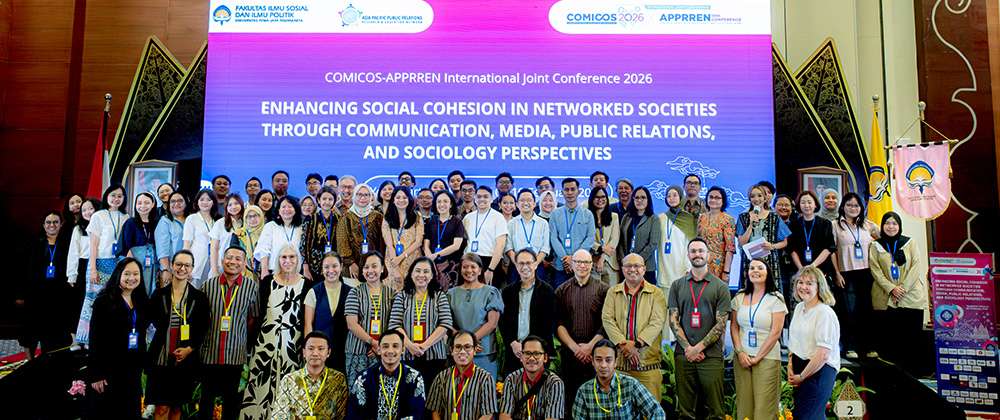
International Joint Conference

Enhancing Social Cohesion in Networked Societies through Communication, Media, Public Relations, and Sociology Perspectives

Conference on Media, Communications, and Sociology (COMICOS) 2026

&

10th Asia-Pacific Public Relations Research and Education Network (APPRREN) Conference

Yogyakarta, Indonesia
09-10 February 2026

Hosted by
Universitas Atma Jaya Yogyakarta (UAJY)

Venue: Sahid Raya Hotel & Convention Yogyakarta, Indonesia

About Us

The Conference on Media, Communications, and Sociology (COMICOS), is a biannual academic forum organized by the Faculty of Social and Political Sciences at Universitas Atma Jaya Yogyakarta (FISIP UAJY). It serves as a dynamic platform that brings together academics, practitioners, and policymakers to engage in discussions on contemporary social science issues.

The Asia-Pacific Public Relations Research and Education Network (APPRREN) International Research Symposium provides a collaborative space for public relations scholars across the region. It facilitates networking, the exchange of ideas, discussions on emerging trends and challenges, and exploration of opportunities for academic and professional collaboration. The symposium aims to enhance our collective understanding of public relations education and research in the Asia-Pacific region.

For 2026, the joint conference of 9th COMICOS and 10th APPRREN will be hosted by Universitas Atma Jaya Yogyakarta.

Theme

Enhancing Social Cohesion in Networked Societies through Communication, Media, Public Relations, and Sociology Perspectives

Sustainable Development Goals (SDGs) have become global focus that aimed to promote diverse, inclusive, interconnected societies, and sustainable world. One of the key concepts capturing this collective spirit is social cohesion which is process of creating a community with common values and opportunities based on mutual trust, hope, and reciprocity (Fonseca et al., 2018). According to the OECD (2011), society fosters a sense of belonging, fosters trust, combats marginalization and exclusion, and provides its members with opportunities for upward mobility. However, experts are unsure about how to address unity and diversity and the thresholds involved. Promoting social cohesion involves developing communities where individuals may coexist despite their differences.

We now live in a network society where the majority of people use social media, which is largely driven by ICT. It can strengthen the sense of identity and promote communication among citizens. For particular communities, social media use has a lot of promise for promoting and preserving social cohesiveness (Stieglitz & Ross, 2022). On the other hand, it presents society with new challenges such as polarization and division. As such, social media can threaten social cohesion.

Alternative approaches to digital citizenship are being presented by a number of academics and practitioners. The ways in which people’s use of digital technology is changing citizenship should be revisited. The “glue” that holds society together and is essential for establishing democracy, peace, and development is social cohesiveness. This “glue” is composed of four essential parts: Social relationships, connectedness, equality, and a focus on the common good.

This conference helps us explore how social cohesion can accurately capture the diversity and multicultural character of contemporary society. Additionally, it offers a framework based on media, communication, sociology, and public relations perspectives in order to identify what drives social cohesiveness and can be used to promote it. Leading academics, educators, and practitioners come together at this event to discuss how we all can contribute to strengthen social cohesion, bridge divides, and create a more diverse, connected society.

Subthemes

1

Media and Technology's Role in Shaping Public Policy, Social Responsibility, and Social Change

Media plays a significant role in shaping social narratives and collective identities. It also serves as a powerful tool for promoting inclusivity and diversity

2

The Impact of Media on Social Movements and Advocacy​

Media serves as a critical tool for amplifying marginalized voices and advancing social justice, operating at the intersection of communication, public relations, and activism. Social media, in particular, both fosters social cohesion and contributes to division, depending on how it is engaged

3

Communication Strategies for Bridging Divided Community

Open and respectful communication is essential for fostering mutual understanding, particularly in diverse and multicultural settings. Effective strategies for intercultural communication, including the ability to navigate and overcome language barriers, play a crucial role in building inclusive and empathetic dialogue

4

Media Literacy (including AI) and its Role in Enhancing Social Cohesion

Enhancing critical thinking and media literacy helps reduce polarization by enabling individuals to identify reliable sources and resist misinformation. Media representations shape societal perceptions and group identities, while storytelling plays a powerful role in reinforcing social values and cohesion.

5

Communication for Conflict Resolution and Social Movement

Communication is key to conflict mediation and peacebuilding, with dialogue, empathy, and active listening enhancing social stability. Public Relations campaigns that prioritize transparency and social responsibility can further build trust and promote positive corporate impact.

6

Public Relations and Crisis Communication for Social Cohesion

Public Relations strategies play a crucial role in managing and recovering from social crises, such as protests or natural disasters, by facilitating clear communication, restoring public trust, and guiding community response efforts.

7

Education, Research, and the Future of Public Relations in Social Cohesion

The future of public relations in promoting social cohesion depends on education and research to develop inclusive strategies. By aligning with societal needs and evolving communication tools, Public Relations can foster trust, equality, and collective action

8

Ethics and Challenges in Public Relations for Social Cohesion

Promoting social cohesion in Public Relations involves ethical challenges, including authenticity, inclusivity, and balancing diverse interests. Professionals must communicate transparently and fairly, aiming to foster unity without compromising integrity or reinforcing inequality

9

The Role of Media in Shaping Shared Values for Equality, Equity, and Inclusivity

Media shapes collective consciousness by influencing perceptions of equality, equity, and inclusivity. Through its broad reach, both traditional and digital media can create, challenge, and transform societal norms and values.

10

Affectivity and Social Cohesion

Emotional connection and empathy, rooted in affectivity, are central to social cohesion. These bonds nurture a sense of trust, belonging, and solidarity, which are essential for building strong and unified communities.

11

Environmental Communication

Environmental communication can help the public and communities understand environmental challenges fostering a sense of shared purpose and uniting people from diverse backgrounds to address these issues. However, it can also lead to polarization or conflict. This panel welcomes presentations of research from the perspectives of strategic communication, media content, and media effects on environmental issue.

Speakers

Opening Remarks

Prof. Dr. Franz Magnis-Suseno

Driyarkara School of Philosophy

Keynote Speakers

Prof. Dr. Øyvind Ihlen

Department of Media and Communication, University of Oslo

Prof. Anne Gregory, Ph.D.

Emeritus Chair of Corporate Communication, Huddersfield Business School, University of Huddersfield

Prof. Gregoria Arum Yudarwati, Ph.D.

Communication Science Department, Universitas Atma Jaya Yogyakarta

PD. Dr. habil. Andreas Schwarz

Institute for Media and Communication Studies (IfMK), Ilmenau University of Technology

Prof. Wayne Bailey

Head of the School of Education Strategic Lead for International in the School of Business, Education and Law, University of Huddersfield

Edwin Falcis Lineses, Ph.D.

Dean of the College of Liberal Arts and Communication, De La Salle University-Dasmariñas (DLSU-D)

Marianne D. Sison, Ph.D., FCPRA

Founder & Chair Asia Pacific Public Relations Research & Education Network (APPRREN), Honorary University Fellow, RMIT University, Australia

Wahyu Dhyatmika, M.A.

Chief Executive Officer of Tempo Digital, Indonesia

Assoc. Prof. Estefanie R. Cortez, Ph.D.

Department of Political Economy, College of Political Science & Public Administration, Polytechnic University of the Philippines

Plenary Speakers

Agenda

Important Dates

FULL PAPER Track

Abstract Submission

28

APR.

2025

1

OCT.

2025

Abstract Submission (EXTENDED)

2-25

OCT.

2025

Acceptance Notification

30

OCT.

2025

8

NOV.

2025

Full Paper Submission*

1

NOV.

2025

16

DEC.

2025

* Full Paper Submission is mandatory for authors who propose to publish their papers in our partner journals.

ABSTRACT-ONLY Track

Abstract Submission Deadline

16

DEC.

2025

Acceptance Notification

22

DEC.

2025

Registration Payment

Early Bird Payment

1-30

NOV.

2025

Regular Payment

1-30

DEC.

2025

Registration

Call for Abstract

Guidelines on submission of abstract

  • Clearly indicate if the submission is a research abstract.
  • All submissions must include the author(s), their affiliations, and accurate contact details.
  • Structured abstracts should include:
    – Title of the research
    – Purpose of the study
    – Methodology used
    – Key findings
    – Implications for practice and theory
    – 3-5 Keywords
    – Maximum length: 300-500 words (excluding references)
  • Blind peer review will be conducted to all submitted abstracts and papers.

Criteria for review abstract​

Originality

- The abstract presents an original idea, concept, perspective or argument to the field one of media, communications, sociology, and public relations.

- The abstract reflects an original research approach to the field one of media, communications, sociology, and public relations.

Contribution to the body of knowledge

- The abstract makes a valid and significant contribution to the field one of media, communications, sociology, and public relations.

- The abstract refers to recent and up to date knowledge in the field one of media, communications, sociology, and public relations.

Structure and presentation

- The abstract clearly defines the problem/message and the topic of the paper.

- The abstract clearly defines the methodology/research approach.

- The argument is presented in a coherent manner.

- The writing style is appropriate for academic/professional presentation.

Relevance

- The abstract clearly reflects relevance to the theme and sub-themes of ‘Enhancing Social Cohesion in Networked Societies through Communication, Media, Public Relations, and Sociology Perspectives’.

- The abstract topic will be of interest to researchers, educators, and practitioners of media, communications, sociology, and public relations.

Submission

For presenters who have received an acceptance letter from the committee, you are now invited to proceed to the final submission stage for the International Joint Conference. Please use the form below to upload your final manuscript (Full Paper) and your presentation materials (e.g., PowerPoint, PDF) by the specified deadline.

The following links are the same as those we provided in the acceptance letter.

Publication Opportunities

1. Abstract-Only Submission
Presenters who submit only an abstract are eligible for inclusion in the book program and will receive a certificate of participation.

2. Full Paper Submission
Presenters who submit a full paper are eligible for publication in SCOPUS-indexed journals, international journals, SINTA-accredited national journals, international conference proceedings. A certificate of participation will also be awarded.

Publications
Please select one of the publication options below that best aligns with your article’s topic, and ensure your draft complies with the formatting guidelines of your chosen publication journal/proceedings.

Academic Publication Partners

Registration Payment *

Category Schedule Registration Fee
Presenter (early bird) 1 Nov – 30 Nov 2025 IDR 1.000.000/ 60 USD
Presenter (regular) 1 Des – 30 Dec 2025 IDR 1.300.000/ 77 USD
Presenter (student) 1 Nov – 30 Dec 2025 IDR 600.000/ 36 USD
Participant (non-student) 1 Nov – 30 Dec 2025 IDR 400.000/ 24 USD
Participant (student) 1 Nov – 30 Dec 2025 IDR 250.000/ 15 USD

TRANSFER TO:  BNI (Bank Negara Indonesia),  Swift code: BNINIDJAXXX

Account Name

Sherly Hindra Negoro

Account Number

1822591773

Postal Code

55281

* Important Note

  • The payment is charged per person, whether as a participant or presenter.
  • For papers with multiple authors, all other co-authors attending the conference are required to register as presenters.
  • The conference registration fee covers conference activities only.
  • Any publication charges required by our partner journals are separate and are the full responsibility of the authors.

Facilities

Full day meeting

Gala Dinner

Seminar kit

Proceeding publication

Book Program

WIFI Access

Co-Host

This international joint conference is proudly co-hosted by a distinguished group of academic institutions whose collaborative spirit and dedication have been pivotal to its success. We extend our sincerest appreciation for their partnership.

Partners

We invite you to partner with us for the International Joint Conference: Enhancing Social Cohesion in Networked Societies through Communication, Media, Public Relations, and Sociology Perspectives. This conference offers a unique platform to connect with leading academics, researchers, and professionals in the field.

We offer various partnership packages tailored to meet your specific objectives. Contact us to explore how we can collaborate to create a mutually beneficial partnership.

University Partners

Sponsors

The International Joint Conference: Enhancing Social Cohesion in Networked Societies through Communication, Media, Public Relations, and Sociology Perspectives, invites you to become a sponsor. This conference provides a valuable opportunity to demonstrate your organization’s support for advancing knowledge and promoting dialogue on this critical issue. As a sponsor, you will receive prominent recognition and access to a diverse and influential audience.

We are open to discussing bespoke sponsorship packages to align with your specific goals. Join us in shaping the conversation on social cohesion in today’s interconnected world. Don’t hesitate to support the organization of this event by becoming an official sponsor. Contact us for sponsorship opportunities.

Download

Please download all required documents for participant guidance, paper submission, and presentation preparation from the list below. The following files and information are the same as those we provided in the acceptance letter.

Full Paper Submission Guidance

Brief instructions on formatting, structure, and requirements for submitting full papers.

author Declaration

A mandatory form confirming manuscript originality and authorship responsibility.

Full Paper Template

The official template to be used for preparing full papers according to conference standards.

Presentation Template

Template for preparing conference presentations with a unified and professional design.

Travel Advisory

Essential travel information, including transportation, accommodation, and venue guidance.

Conference Schedule

Schedule and rundown of the day-by-day agenda of the International Joint Conference in detail.

Parallel Session Schedule

Find your designated presentation timing, room location, and session details by accessing our complete Parallel Session Schedule.

Program Book

Access the UPDATED Program Book for the complete conference itinerary, speakers, and session abstracts.

Proceedings

Access the Proceedings of COMICOS & APPRREN International Joint Conference

Contact

We look forward to receiving your submissions and engaging in meaningful discussions on the critical role of public relations in promoting social cohesion.

For further inquiries, please contact us, comicos@uajy.ac.id

Contact Person: Brahma +62 818 0339 6299

📍Teresa Building, Faculty of Social and Political Sciences,

Universitas Atma Jaya Yogyakarta, Indonesia

Jl. Babarsari No. 6 Yogyakarta, Indonesia

Instagram: @comicosuajy

Facebook: comicosuajy